Warning: Kinder Teacher Enters the “Real World”
The Kenan Fellowship Experience Continues…
I entered the Structural Adhesive Department of LORD Corporation’s Process Development Center early Monday morning, the first day of my Kenan Fellows externship. Mistake number one: wearing a dress and sandals, not exactly “lab attire.” But that didn’t matter, because I was quickly overwhelmed with the buzzing excitement of the real world. As teachers, we prepare our students for the real world every single day, and hopefully we are providing ample opportunities for our students to interact with authentic, real world situations and materials…but as teachers, we rarely get the chance to be in the real world.


As I toured the facilities, my excitement for this special opportunity grew and my eyes 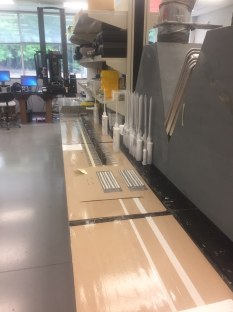 were opened to the true value of the Kenan Fellowship program. There should be thousands of innovative opportunities like this, to broaden our educator perspectives and to remind of us of why we do what we do. Inside the labs were chemists and chemical engineers, working to create adhesives that both strengthen and increase the aesthetics of cars. My mentor John Lean described some of the new types of adhesives they were working on for electric car batteries, along with showing me the hundreds of thousands of dollars of equipment used to test LORD’s adhesives. One machine even crash tests the strength of their adhesives to mimic that of a car crash…woah.


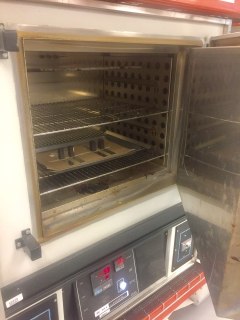
My mind churned with ideas I could bring back to my kinders…big picture ideas that would help them see the value in science and how it solves problems and affects our daily lives. At this point, I still had no clue what I would be doing in the labs during my 3 weeks, yet I already had the beginnings of ideas for what my students might explore or create. I met with my mentor at the end of my first day to discuss my project, which would relate to my project for my students. Starting with the end in mind, I asked him what he sees as a need in preparing students for STEM careers like LORD. He began describing the impact that many variables play in affecting different outcomes of the same process, and then handed me a large notebook of process mapping information, accompanied by the actual process I would be experimenting with. I would be completing the same process repeatedly, bonding 2 metal coupons with the same adhesive, and after a day taken to cure for each batch, I would use an Instron machine to measure the force required to pull the coupons apart. He explained that while I might follow the same steps each time, there are different variables that will affect different outcomes in the force measurement each time. I was tasked with creating a process map to outline the steps, and then identifying any variables (room temperature, dispersion of adhesive, coverage of substrate, amount of glass beads, size of static mixer, etc.) that could possibly influence different outcomes in the process. The ultimate goal of my experimentation was to control the outside variables as much as possible in order to obtain similar results each time. Ready….GO!
My first thought: Kindergarteners? Variables? Process mapping? Hmmm…this should be interesting.
My second thought: Me? Dispensing adhesive? Bonding metal? Process mapping? Measuring force?
My third thought: There must be value in this process…what is it, and how can I share it with my students?
And when I thought back to how LORD affects the daily lives and safety of people with their products, I realized why it was so important that a process be as controlled as possible so that it can produce the consistently proven results it was designed to produce – results that end up in people’s cars. And that moment was when my head started spinning with ways I could not only keep the big picture ideas I had started with in mind, but blend those ideas with this new important aspect that my experience was already beginning to teach me.
 Now you might be wondering how I’m so comfortable using the lingo and terms above, maybe not…but if I had read this post before I began my externship, I would most definitely be wondering. The open-ended experience of creating a process map for my task, with nothing to go off of other than an abstract formula and example of the process mapping for making scrambled eggs (and Google), is what got me to this point of comfort with the terminology and steps of the process. And the best part – creating the process map gave me a genuine appreciation for how a challenge, without prior modeling or an outline of steps to follow for completion, can engage and grow someone. It also effectively prepared me for the chemical research and experimentation I began this past week. No one gave chemical engineers a guide to the adhesives they would create: they used their background knowledge and resources to problem-solve through trial and error, making mistakes along the way as I have. And it’s not often that I’m on the learning side of a challenge, but I am LOVING it! THANK YOU, KENAN FELLOWS PROGRAM!!!!
Wrap-Up: My Transforming View of Science
When I was offered this externship, I really wasn’t sure how I would get the job done. The description sounded so cool but also so out of my element, which is part of what drew me to it, but also what made it a little intimidating. But it has also taught me about myself and how I should never be scared to take on something that seems “not me.” Just because I have to wear a lab coat and safety glasses and am tasked with chemical research does not mean I can’t do it! The stigmas embedded in the words science and chemistry are probably what have held me back from diving all in for many years, and I know I’m not alone in that – there are many other teachers and students who feel that same way. Using a bunch of big words and conducting random experiments can seem confusing and meaningless…science is not. Now science can be complex, but with a growth mindset, those complex things can be learned when there is meaning and purpose behind them. This experience in the real world is just what I needed to continue transforming my view of science, and I am so excited to present science to my students from the new perspective I am learning this summer! Stay tuned to see how my project for Kindergarteners develops!


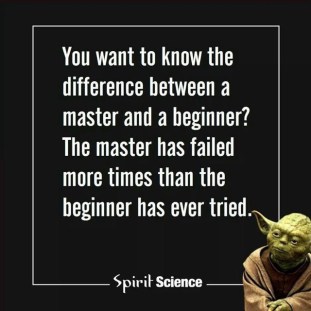 This fixed mindset in students becomes a problem. And Kindergarten is the pivotal age to begin addressing this issue of mindset, as the achievement and opportunity gap begins dividing students from the first day of K on. Their beliefs about themselves are holding them back from where they could be. Research shows that when we practice a skill, our brain gets stronger and more proficient with that skill; and the more we get into the habit of absorbing new information and taking part in the struggle of the learning process, the better we get at new skills and at learning in general. Contrary to what was believed for many years, there aren’t “math” people or “word” people…we can all be any kind of people we want if we practice and persist through challenges.
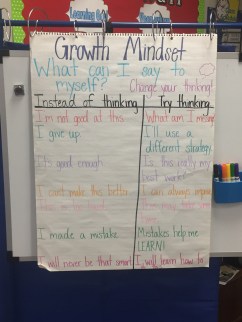 –Language: The videos we have watched and conversations happening in our morning meeting have transformed our overall language. Now you might hear an “I can’t do it…YET.” And if that yet doesn’t make it to the end of the phrase, you can bet the people sitting near that student will chime in with a YET to remind their friend of a growth mindset. Another phrase we love and have adopted from the Class Dojo videos is to “take the challenge,” rather than run away or give up. That has really taken the place of “this is too hard,” as students are now inspired to “take the challenge” and get better at whatever skill they are practicing. A fellow K teacher on my team,
  –Focus on practice: We talk about practice all the time now. Students are seeing that the learning activities we take part in throughout the day ARE practice that help us learn. Tasks are no longer scary, they are practice. And students are less scared to take risks, because they know that trying it is how you learn. This has been a big mindset shift. A couple of students have used the phrase “practice makes perfect,” and are usually now stopped by other students who remind them, “there’s no such thing as perfect…we can always get better!” Once recently, a student got an answer wrong, and another student giggled. One student got very defensive for her peer who had gotten the answer wrong, and said “It’s not funny! He is learning, and you have to try it to learn!” In another instance, a couple of students were questioned by another student for having to complete their work at a teacher’s table for extra support, an outsider listening in again jumped to their defense, saying “They may not have had as much practice as you before…sitting with the teacher helps them get better practice to learn!” As a group, our language has transformed, and when we go back to “old language,” you can see how other students jump to the defense.


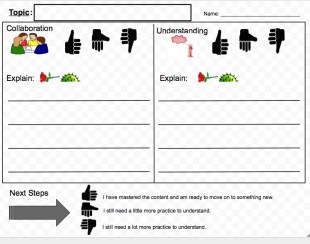 –Reflection: After these challenging STEM activities, it is always important to reflect on the activities and on student mindset. We ask what was easy, what was hard, and next steps. Students are now identifying times when they went into “the dip,” or when they really had to show perseverance to get through a challenge, or how they still need a little more practice to master a skill. Reflection is also what we do in our Morning Meeting, when sharing personal experiences or responding to Mojo’s experiences in the video clips we watch. We reflect orally often, and at this point in the year, have also started reflecting using
  worry about whether taking a risk could result in complete failure, or whether I’d have to defend a questionable choice I made, or whether I’d be capable of making it through school. I always had confidence I could do it all, and it is vital to remember that not everyone’s experiences instill that level of confidence! Building up confidence in learners from day one is really more important than anything else they could learn; and it is part of what many groups or students need in order to be on an equitable playing field with their peers. So before assuming students “can’t do it,” help them believe that they can; give them the right level of instruction, tools, and opportunities for practice; have them reflect on what they can do when they have a growth mindset; and work with them to build confidence that pours into all the areas of their lives. That’s one of the best ways we can ensure equity and genuinely change lives in this profession.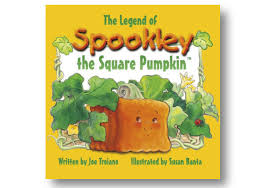
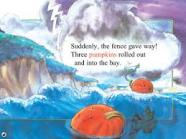 Spookley helped save the day by using his square shape to block the crack in the fence. Our job was to create a new solution to the story: using a chosen material, students were put into groups to collaboratively build a fence with their material. Students were asked to build a strong fence that would not break when the storm came and shook up the pumpkins.



 Learning with the Littles