Collaborative Learning: Misconceptions, Misrepresentations, & What We’re Doing About It
Students and parents, raise your hand if you jump up and down when you hear the words “group work”?! If you’re raising your hand, you are not the norm. For most, phrases like “group work” or “group projects” create anxiety, dread, and resent. But why??? Collaboration as a means of 21st century learning has been a buzz word since before I started teaching 4 and a half years ago, and for great reason! Collaborative learning is an authentic replication of work in the real world, a way for students to learn from one another and experience other perspectives, a way of appealing to the interpersonal intelligence for those whose are motivated to learn with others, and so much more. Sure, collaboration is challenging…no one every said that putting a bunch of different ideas in the mix made it easier to come to an agreement. But collaborative learning should be seen as an engaging and worthwhile challenge for both those participating (students) and watching from afar (parents). I’ve noticed parents requesting more worksheets over collaborative learning, and heard of parents not choosing particular schools because of a focus on collaborative work. So why do the people being affected by collaborative learning often dislike it so much? They are the ones who should be benefiting!


In shifting from the role of a student myself to a teacher, I’ve gradually noticed a shift in my own perspective on collaboration as a means of learning. As a student, I generally didn’t care for it. As the stereotypical student overachiever, working in groups generally resulted in me attempting to micromanage the whole project as if it were my own individual project, or if that didn’t work, resulted in me stressing over whether others would follow through with their parts or negatively affect my grade. In both types of scenarios, grades were the focus and learning was stifled for me and/or other group members. Additionally, these types of activities were more about dividing the large project into smaller “sub-projects,” so each group member usually ended up working independently rather than collaboratively. But my shift to the role of teacher has opened my eyes to the value that collaboration can genuinely have on both social-emotional and content-specific learning. So what exactly are the problems students are experiencing in this dreaded type of collaborative learning, and what can we teachers do about it?
1. Teamwork vs. Collaboration
First things first, let’s be clear on the definitions of terms. Many “group projects” are not collaborative in nature, but activities requiring teamwork.
Teamwork is when everyone takes on a smaller piece of the larger project; and when each of those small pieces are put together, the larger project is complete. There is definitely a time and place for teamwork, whether students each take on a specific job in the work or complete a certain section of the work. Yes, in the real world, this is a realistic model for work completion. But the goal of these activities should not necessarily be to teach the concept of working together, or collaboration. When taking part in teamwork, people work more so individually.
Collaboration, on the other hand, is when a group creates something together from the ground up. The team creates the idea collectively, and all members pitch in however possible to put the idea into action. These collaborative activities are the ones that genuinely teach students how to work effectively with others, appreciate perspectives different from their own, and respond to different ideas and opinions.
2. Grades vs. Reflection
In either situation, whether teamwork or collaboration, the emphasis should be on reflection to become better rather than on grades.
Grades often squelch learning, particularly collaborative learning, which is already a challenge without tying a grade to it. Placing a grade on collaborative activities creates a pressure that causes the learners involved increased frustration and resentment. When disagreements arise, now the goal has shifted from “How can we effectively come to an agreement?” to “If we don’t hurry up and come to an agreement, we won’t get a good grade,” or “If these people don’t listen to my idea we’re gonna fail.” Grades have the potential to teach ineffective collaboration and add frustration to an already challenging process.
Reflection helps learners think back on the experience in an honest way. Without the pressure of grades, students can feel freedom to be realistic about their learning and collaborative efforts in a given activity. When reflecting honestly, students can acknowledge mistakes they might have made during the process, in efforts to learn from those mistakes and become better for next time. In fact, reflection (over grades) might help learners see the positive, rather than the negative and failure, in mistakes.
3. Culminating Projects vs. Learning
Collaborative learning often takes place at the end of a unit, as a summative project reflecting what students learned (to give a grade), rather than as PART of the learning process.
Culminating projects involving collaboration usually remove learning from the experience. Often, collaborative projects are simply supposed to reflect what members of the group have learned for a final grade. Similar to the idea of projects versus project-based learning, a culminating project may as well be the word “test,” again creating added pressure to an already challenging skill.
Learning happens throughout a unit, not at the end. Collaboration is a great, engaging way to teach new content, while also building students’ collaborative skillset. A collaborative type of activity should more often happen along the way as students learn, not always at the end of the unit. If it could just be approached as part of the learning process, rather than a final “show what you know” group project, it might not be so intimidating and stressful.
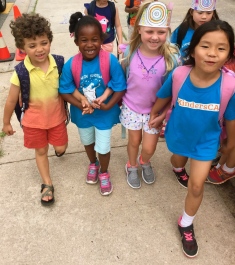 It is hard to believe that my 4th year of teaching is coming to a close. Being completely transparent, this year has challenged me in ways I have never experienced, both resulting from professional growth opportunities that I have voluntarily taken on and from the quality and quantity of needs among the students in my class. There have been glimpses of joy and rewarding moments that have of course made the year worthwhile, but I have also experienced my fair share of difficulty in a variety of ways. Even though I know it is my job to meet my learners where they are, it has felt discouraging at times to modify and even totally change routines and activities that have worked for past years. With many years ahead of me in my career and only a few behind me, I predict that there will be many “types” of school years, each unique in growing my practice and building the educator stamina that I have been building since year 1.


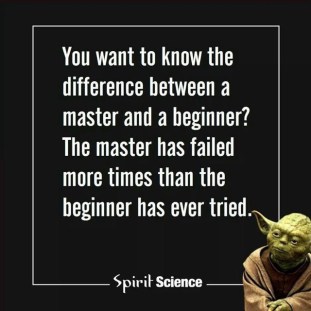 This fixed mindset in students becomes a problem. And Kindergarten is the pivotal age to begin addressing this issue of mindset, as the achievement and opportunity gap begins dividing students from the first day of K on. Their beliefs about themselves are holding them back from where they could be. Research shows that when we practice a skill, our brain gets stronger and more proficient with that skill; and the more we get into the habit of absorbing new information and taking part in the struggle of the learning process, the better we get at new skills and at learning in general. Contrary to what was believed for many years, there aren’t “math” people or “word” people…we can all be any kind of people we want if we practice and persist through challenges.
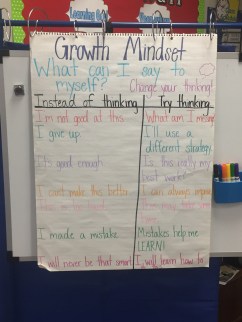 –Language: The videos we have watched and conversations happening in our morning meeting have transformed our overall language. Now you might hear an “I can’t do it…YET.” And if that yet doesn’t make it to the end of the phrase, you can bet the people sitting near that student will chime in with a YET to remind their friend of a growth mindset. Another phrase we love and have adopted from the Class Dojo videos is to “take the challenge,” rather than run away or give up. That has really taken the place of “this is too hard,” as students are now inspired to “take the challenge” and get better at whatever skill they are practicing. A fellow K teacher on my team,
 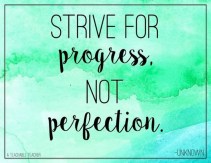 –Focus on practice: We talk about practice all the time now. Students are seeing that the learning activities we take part in throughout the day ARE practice that help us learn. Tasks are no longer scary, they are practice. And students are less scared to take risks, because they know that trying it is how you learn. This has been a big mindset shift. A couple of students have used the phrase “practice makes perfect,” and are usually now stopped by other students who remind them, “there’s no such thing as perfect…we can always get better!” Once recently, a student got an answer wrong, and another student giggled. One student got very defensive for her peer who had gotten the answer wrong, and said “It’s not funny! He is learning, and you have to try it to learn!” In another instance, a couple of students were questioned by another student for having to complete their work at a teacher’s table for extra support, an outsider listening in again jumped to their defense, saying “They may not have had as much practice as you before…sitting with the teacher helps them get better practice to learn!” As a group, our language has transformed, and when we go back to “old language,” you can see how other students jump to the defense.


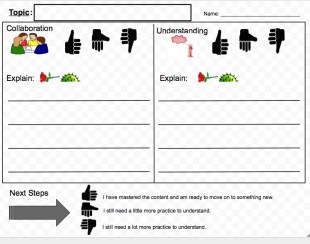 –Reflection: After these challenging STEM activities, it is always important to reflect on the activities and on student mindset. We ask what was easy, what was hard, and next steps. Students are now identifying times when they went into “the dip,” or when they really had to show perseverance to get through a challenge, or how they still need a little more practice to master a skill. Reflection is also what we do in our Morning Meeting, when sharing personal experiences or responding to Mojo’s experiences in the video clips we watch. We reflect orally often, and at this point in the year, have also started reflecting using
  worry about whether taking a risk could result in complete failure, or whether I’d have to defend a questionable choice I made, or whether I’d be capable of making it through school. I always had confidence I could do it all, and it is vital to remember that not everyone’s experiences instill that level of confidence! Building up confidence in learners from day one is really more important than anything else they could learn; and it is part of what many groups or students need in order to be on an equitable playing field with their peers. So before assuming students “can’t do it,” help them believe that they can; give them the right level of instruction, tools, and opportunities for practice; have them reflect on what they can do when they have a growth mindset; and work with them to build confidence that pours into all the areas of their lives. That’s one of the best ways we can ensure equity and genuinely change lives in this profession.
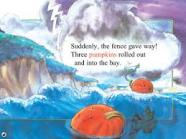 Spookley helped save the day by using his square shape to block the crack in the fence. Our job was to create a new solution to the story: using a chosen material, students were put into groups to collaboratively build a fence with their material. Students were asked to build a strong fence that would not break when the storm came and shook up the pumpkins.


 Learning with the Littles