Remote Learning in 3-2-1…Go!


It’s hard to remember what life felt like a month ago, interacting face-to-face 5 days a week with my students and teammates. And here we are now, “enjoying spring break”…AKA making final preparations for a totally different way of doing school that will all begin next week. Education across the world is seeing some temporary yet significant shifts (and who knows what the long-term impacts on education will be). Shifts toward virtual/online options for “doing life” – education related or non – have been happening for years, and we are so lucky to live during time when we have all of these digital options. But in the last month across our state, country, and world, things have reached a new level of “remote.”
In education, when the governor of the state you live in says that schools are going to shift to remote learning during this time of school closures, that is indeed what the schools of that state will do. One day at a time, teachers have been getting new bits of clarity on what this remote learning will look like and what our district’s expectations for this state-promised remote learning are. And each day therefore has become more overwhelming, not just for educators, but for our families too. There isn’t physically enough time to work out the kinks that impact both teachers and families prior to the start of remote learning: access to devices for students, access to internet for students, building a remote learning plan that fits the needs of everyone involved, planning new ways of teaching content, creating virtual instruction, creating assignments and options for submitting them, informing students and families of all the expectations, and assisting families as they too prepare and connect to our virtual classrooms.
Then you add the element of Kindergarten to the whole situation: how will such a young group of learners be able to independently access, create, and submit work for remote learning? 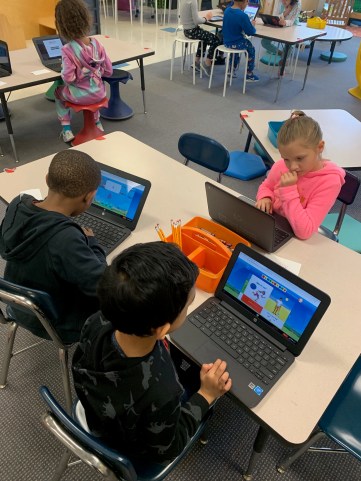 The Kindergarten grade level has rigorous curriculum standards, so just telling the kids to have some playtime or build something creative or paint something they like for every assignment would unfortunately be failing to meet the expectations of the grade level (not that we don’t try to integrate those types of play-based activities into the curriculum any chance we get). But just as high schoolers on the Common Core will follow a remote learning schedule, receive virtual CORE instruction, and submit assignments digitally, so will Kindergartners. Imagine the kind of pressure that puts on the parents and guardians of Kindergarten and elementary-aged students right now. And then imagine the pressure on parents, particularly working parents, with MULTIPLE children of this age group.
My team and I, among many other educators right now, are in an entire realm of unknown. Yes, the WCPSS district is emphasizing grace, grace right now for all the educators and families who are traveling through this uncharted territory. But giving grace does not mean that this isn’t all starting on April 13th. So being aware of the inequities, impossibilities, and uncertainties embedded in the remote learning we are heading for next week, here is how my Kindergarten team is navigating it all:
1. Make a teacher space within our homes.  Here is what was previously my kitchen table, but now serves as my classroom! All I need is an iPad, iPad stand, whiteboard/marker/eraser, and my laptop/its resources to make this happen! Oh, and some pasta shells that I used as my math manipulatives to video a lesson on adding. But that’s it! Which just further shows that the most important part of learning is what is not pictured here……the teachers and the students!
2. Connect with families and listen to their needs and concerns. Our team called each of our families to check on them and find out about their device and internet needs prior to even knowing anything about what remote learning would look like. We gave them a chance to voice concerns they had health-wise as well as with remote learning. Their concerns helped shape our understanding of the impact that learning at home will have on their lives, and gave us insight we needed before jumping into all the planning.
3. Get ready for a whole lotta Google Meets together. 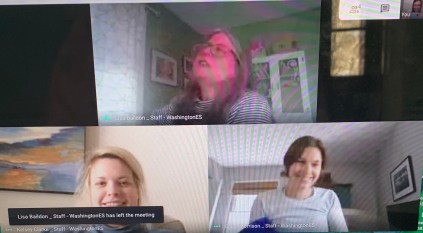
The Google Meet seen above was from last week and lasted almost 4 hours…it takes so much planning to make decisions about how and what to teach and create in this new school “environment,” while also taking into account how families will receive and be impacted by whatever decisions we make. You may notice the blurry picture quality, due to poor/shared internet connections at home. You might also see that the Google Meet screenshot pictured says that “Lisa Baildon left the meeting,” while she is also there at the top of the screen- we’ve only had a few of these little “technical difficulties” (and lots of laughs about them) so far.
4. Make a hyperlinked schedule that outlines weekly expectations with as much flexibility as possible.
 We created a hyperlinked schedule, which has become both how we plan/embed instruction and assignments, as well as how students will access the learning. Our schedule incorporates a lot of flexibility. We’ve given recommended time blocks for different subjects, but not a time of the day it must be done. We plan to share the schedule of instruction and assignments a week at a time so that families can have access to 5 days at a time and see what lies ahead. Assignments are not due on the day they are given, but the following week. We hold daily office hours, as well as flexible Fridays, to connect with students and answer questions students and families have.
5. Create a letter for parents, with embedded videos, outlining what to expect and how to access the learning. This letter to families from our team explains how to access online learning, what to expect, and as much as we know about how it will all work. Parents are receiving this letter over a week prior to the start of online learning, so that we have time to answer their questions and get everyone prepared for a successful start.
6. Give choice in how to complete and submit assignments, and not ALL tasks are digital. We created a box at the bottom of the hyperlinked schedule that gives options for submitting work. Students might type a document, hand-write a writing piece and take a photo of it, or video themselves presenting the content on any given assignment! We’ve also given them multiple online platform options to access and submit work so that they and their parents can do it the way that they are comfortable. Printing materials is an option for some student assignments, but never a requirement. And most importantly, not every assignment involves learning and working on a digital device. While tasks have to be accessed digitally, not all work has to be completed digitally. It was important to parents to have a balance of learning with and without technology.
7. Get feedback using a Google Form to see how things went and what changes we could potentially make for improvement.
 We will share this Google Form with families after week one. Thanks to our Literacy Coach, Dan Gridley, for this idea! This will allow us to continue gaining feedback to improve what, in some ways, feels like a brand new practice!
These are stressful times, but I’m so thankful to take this on in collaboration with an incredible, supportive team and in partnership with amazing school community and families! We whole-heartedly support our families through this change in education and understand that they will each complete and prioritize online learning differently. People don’t always think about the role parents must play in order for young children to take part in remote learning- parents deserve major recognition during this time for any efforts they are able to put forward to support their children’s learning while schools are closed. We are ready to give this our best try, and hope to be back together, face-to-face with each other and with our students again soon!




 While this problem may be magnified on the Kindergarten level due to their young age and newness to school, I know that this is something that teachers of all grade levels encounter: starting over with a new class, a year younger than the class you just finished with. Shout-out to my friend
  Before the kids arrive, I have found it helpful to make lists. Not just a list for the thousand things I have to do to get the room ready, but a list, broken into categories, to outline expectations, routines, activities, flexible seating expectations, and protocols students need to learn to get the classroom up and running. My list is categorized into 3 sections:

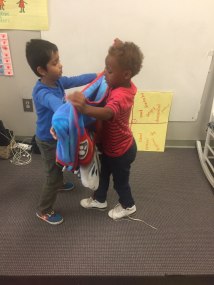 Sometimes a routine or procedure has already been taught, but each day we complete it, there are issues. Whether it’s a flexible seating or classroom library procedure, it’s easy to become frustrated when it was taught but isn’t being followed. I used to keep the mindset that it has been taught, I just reviewed it impatiently, and it will be a waste of our time to go back and fully re-teach; but at a BT meeting a couple years ago, the mentors in the room reminded me that it was never a waste of time to strengthen a routine in the classroom. At the time, I had been feeling so pressured to keep up with the curriculum that I had undermined the importance of filling in those gaps. Filling in the foundational gaps students may have missed not only brings sanity to you, it brings clarity to them and helps the classroom run more efficiently in the long-run. So rather than become frustrated with myself or them, I’m learning to take the time to fully re-teach the expectation in a new way.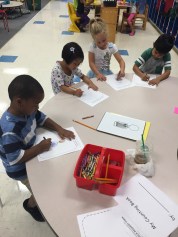


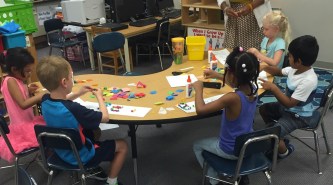
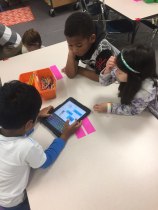


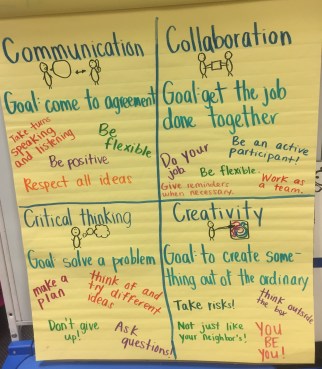 Going along with the social skills foundation that students need, it is important to get students collaborating, communicating, thinking critically, and creating right away. While keeping up with the curriculum and teaching it effectively creates curriculum experts, we want well-rounded experts with 21st century foundational skills! Each of the 4Cs can be taught through one larger 4C activity, or through individual 4C activities highlighting each C. It is helpful to integrate literacy as these skills are introduced. Last year,
 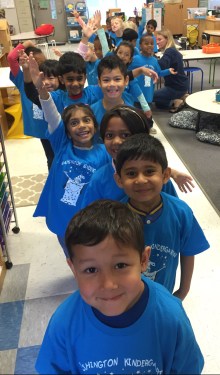 Taking the time to reflect on my beginning of year organization strategies for diving in with a new class has allowed me to more clearly define the structures I’ve informally adopted. Maybe this structure has given others some thoughts or ideas to ponder or tweak to make your own, or maybe you have some of your own tips to share in the comments below! I love the beginning of school and tend to want to rush right into the fun learning and excitement, but I and my students also thrive in a structured, organized environment. We teachers have to be strategic in order to dive right in WHILE building the foundation up! Even though I’ve worked most of my summer away and feel like I’ve hardly had a chance to blink since the last school year, I am ready and SO excited to get started with my 18-19 class of Kindergarteners!!!

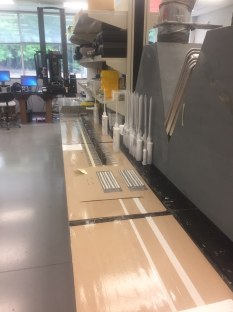 were opened to the true value of the Kenan Fellowship program. There should be thousands of innovative opportunities like this, to broaden our educator perspectives and to remind of us of why we do what we do. Inside the labs were chemists and chemical engineers, working to create adhesives that both strengthen and increase the aesthetics of cars. My mentor John Lean described some of the new types of adhesives they were working on for electric car batteries, along with showing me the hundreds of thousands of dollars of equipment used to test LORD’s adhesives. One machine even crash tests the strength of their adhesives to mimic that of a car crash…woah.


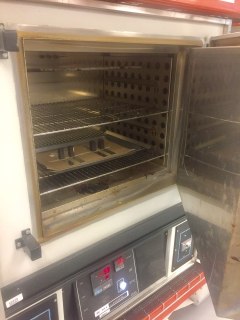 Now you might be wondering how I’m so comfortable using the lingo and terms above, maybe not…but if I had read this post before I began my externship, I would most definitely be wondering. The open-ended experience of creating a

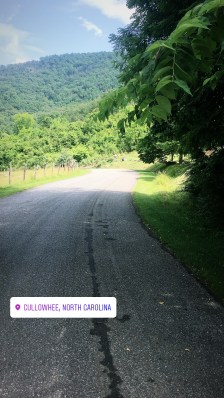 I started my summer this year packing my bags to head for Cullowhee, North Carolina, almost the farthest western point of the state! What I knew: I’d get to meet the 24 other educators from across the state, who had also been selected as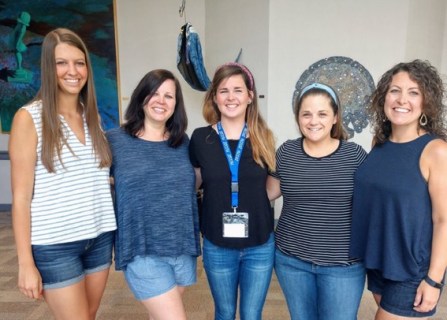


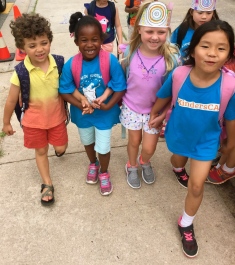 It is hard to believe that my 4th year of teaching is coming to a close. Being completely transparent, this year has challenged me in ways I have never experienced, both resulting from professional growth opportunities that I have voluntarily taken on and from the quality and quantity of needs among the students in my class. There have been glimpses of joy and rewarding moments that have of course made the year worthwhile, but I have also experienced my fair share of difficulty in a variety of ways. Even though I know it is my job to meet my learners where they are, it has felt discouraging at times to modify and even totally change routines and activities that have worked for past years. With many years ahead of me in my career and only a few behind me, I predict that there will be many “types” of school years, each unique in growing my practice and building the educator stamina that I have been building since year 1.


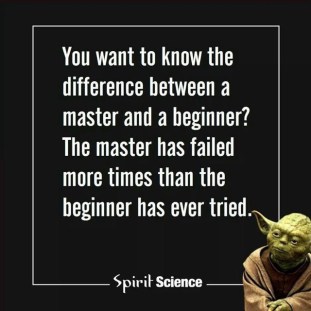 This fixed mindset in students becomes a problem. And Kindergarten is the pivotal age to begin addressing this issue of mindset, as the achievement and opportunity gap begins dividing students from the first day of K on. Their beliefs about themselves are holding them back from where they could be. Research shows that when we practice a skill, our brain gets stronger and more proficient with that skill; and the more we get into the habit of absorbing new information and taking part in the struggle of the learning process, the better we get at new skills and at learning in general. Contrary to what was believed for many years, there aren’t “math” people or “word” people…we can all be any kind of people we want if we practice and persist through challenges.
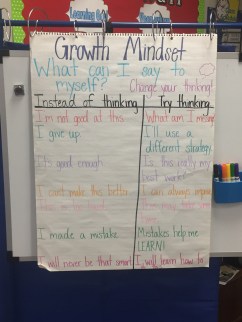 –Language: The videos we have watched and conversations happening in our morning meeting have transformed our overall language. Now you might hear an “I can’t do it…YET.” And if that yet doesn’t make it to the end of the phrase, you can bet the people sitting near that student will chime in with a YET to remind their friend of a growth mindset. Another phrase we love and have adopted from the Class Dojo videos is to “take the challenge,” rather than run away or give up. That has really taken the place of “this is too hard,” as students are now inspired to “take the challenge” and get better at whatever skill they are practicing. A fellow K teacher on my team,
 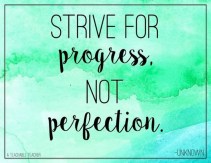 –Focus on practice: We talk about practice all the time now. Students are seeing that the learning activities we take part in throughout the day ARE practice that help us learn. Tasks are no longer scary, they are practice. And students are less scared to take risks, because they know that trying it is how you learn. This has been a big mindset shift. A couple of students have used the phrase “practice makes perfect,” and are usually now stopped by other students who remind them, “there’s no such thing as perfect…we can always get better!” Once recently, a student got an answer wrong, and another student giggled. One student got very defensive for her peer who had gotten the answer wrong, and said “It’s not funny! He is learning, and you have to try it to learn!” In another instance, a couple of students were questioned by another student for having to complete their work at a teacher’s table for extra support, an outsider listening in again jumped to their defense, saying “They may not have had as much practice as you before…sitting with the teacher helps them get better practice to learn!” As a group, our language has transformed, and when we go back to “old language,” you can see how other students jump to the defense.


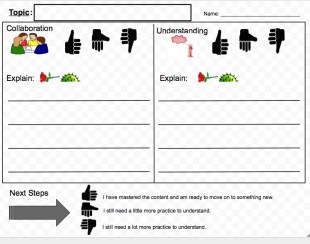 –Reflection: After these challenging STEM activities, it is always important to reflect on the activities and on student mindset. We ask what was easy, what was hard, and next steps. Students are now identifying times when they went into “the dip,” or when they really had to show perseverance to get through a challenge, or how they still need a little more practice to master a skill. Reflection is also what we do in our Morning Meeting, when sharing personal experiences or responding to Mojo’s experiences in the video clips we watch. We reflect orally often, and at this point in the year, have also started reflecting using
  worry about whether taking a risk could result in complete failure, or whether I’d have to defend a questionable choice I made, or whether I’d be capable of making it through school. I always had confidence I could do it all, and it is vital to remember that not everyone’s experiences instill that level of confidence! Building up confidence in learners from day one is really more important than anything else they could learn; and it is part of what many groups or students need in order to be on an equitable playing field with their peers. So before assuming students “can’t do it,” help them believe that they can; give them the right level of instruction, tools, and opportunities for practice; have them reflect on what they can do when they have a growth mindset; and work with them to build confidence that pours into all the areas of their lives. That’s one of the best ways we can ensure equity and genuinely change lives in this profession.
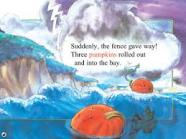 Spookley helped save the day by using his square shape to block the crack in the fence. Our job was to create a new solution to the story: using a chosen material, students were put into groups to collaboratively build a fence with their material. Students were asked to build a strong fence that would not break when the storm came and shook up the pumpkins.


 Learning with the Littles